
“I’m going to order a scan for pre-diabetes.” My doctor told me casually, her eyes glued to the computer screen that housed all my information in the patient room of Texas Children’s Pediatrics Clinic during my yearly wellness checkup.
“Wait, what?”
“Your BMI is in the higher range, so we want to check for that. Just in case.”
My eyebrows were probably raised to the ceilings at that point as she rattled on about “standard procedure.” As were, apparently…my obesity levels?
Me, unhealthy? Me, overweight? Me, a varsity swimmer who trained for up to four hours a day? Who had competed in state and national level competitions for my sport? Who, on occasion, flexed my biceps in the mirror with a decided measure of pride?
Yet, I was considered, in the eyes of the medical community, overweight and so unhealthy I needed to be scanned for a condition that usually affected obese and sedentary teens with other health problems. Based off of what? My “BMI,” whatever that was?!
I got into my car after the appointment and sat there for a moment in silence.
Then, I did what any self respecting woman would do — I turned on a podcast pertaining to the topic and went on a deep dive.
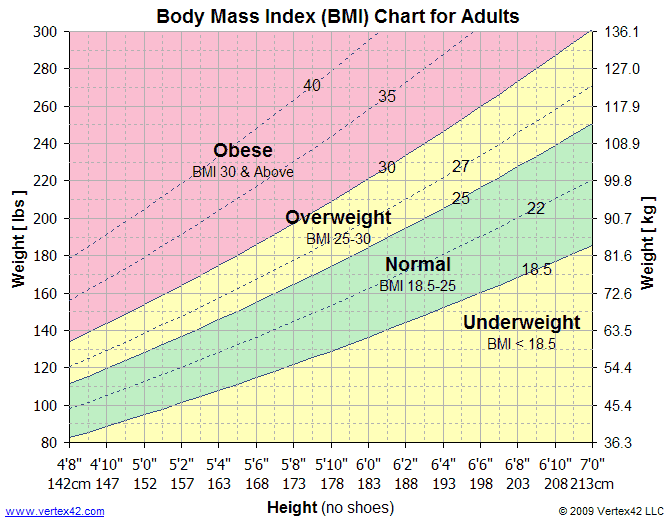
The concept of BMI, or Body Mass index is relatively simple. According to the all knowing CDC, BMI is “body weight (in kilograms) divided by the square of their height (in meters).”
Now, you might ask, how was that complicated sounding formula found?
The concept of a “Body Mass Index” emerged in the 1830s by an astute Belgian mathematician named Lampert Quetelet. Ol’ boy Lampert wanted to find the “average man,” and he measured a lot of his fellow Belgian bros and did a lot of mathy stuff until he had a formula. (Bear in mind Lampert didn’t even have a calculator back then.)
Lampert was not a doctor, not a health scientist, but a math guy, ancestor to the modern version of Steven from Algebra class. Fast forward a century to the 1960s to the beginnings of an obesity epidemic, and a man named Ancel Keys dusted off the forgotten formula with a glorious vision of standardizing obesity.
To his credit, he did do some research before helping to implement it into the American healthcare system. He tested 12 groups of people, all of them men, an improvement from the one group in Lampert’s study. Apparently they were “healthy,” but it’s unclear what metric that was determined with.
And this was enough proof to make a health standard to be used widespread in every facet of American medicine: because, of course, only twelve groups of people exist in America. And none of them are women.
We have very few health processes that have remained unchanged at least a little bit for two hundred years. Even the Hippocratic Oath is spoken in English rather than the original Greek. But the BMI has not strayed from its unapologetically Belgian roots.
But we don’t have to rely upon conjecture about the legitimacy of the original results: we have real, scientific, modern data that isn’t from the 1830s that very clearly spells out that BMI is not an accurate measure of an individual’s health. And sometimes, faulty measurements can lead to deadly assumptions.
For decades, the medical precedent has been that lower BMI = better health. Asian people, who statistically have lower BMIs were viewed traditionally as low risk for heart disease and diabetes. But according to a recent study by the American Heart Association, this isn’t the case at all, because demographically their fat distribution is in their middle–a place associated with higher risk for cardiovascular disease. As a result, there is virtually no research on specifically Asian heart disease – a disastrous reality for those facing those issues.
Part of it doesn’t need fancy statistics or startling exposes: one of the strongest arguments against the accuracy of BMI is found in its own measurements. Allow me to demonstrate to you the crown jewel in the royal splendor of the failures of BMI:
John Smith is a bodybuilding gym bro who guzzles protein shakes like water and has been bulking since he was three years old. He weighs 170 pounds and is 5’4. His BMI is 29.2
Now let’s look at his brother, Smith John. Smith is an intellectual and doesn’t overly concern himself with the duties of the flesh. He spends his days eating ice cream and Ding Dongs from his mother’s basement while arguing chaos theory on Discord. He’s the same height as his brother but weighs 145 pounds. He is much taller horizontally, to put it delicately. His BMI is 24.9.
We both know which one is healthier. But BMI would tell you Smith is living a good lifestyle and should keep doing what he’s doing, and would tell you John is overweight and needs to work out more and eat better. This is pure idiocy. We might as well theorize the world is flat, or 2+2=5.
Why are we ignoring reality to take refuge in a number that acknowledges it isn’t even correct in most circumstances? Would we refuse to fix a clock because it “gives us a general idea about what the time could be?” No! We would fix the clock, or throw it out and get a new one. It’s time to stop chaining ourselves to the shackles of tradition.
And the good thing is that modern science has already dropped several alternatives on our proverbial doorstep. Measuring your stomach diameter, or visceral fat is scientifically proven to be a better indicator of obesity risks than BMI. If you want an even fuller picture, full body scanners look at fat distributions and percentages. I took one of these recently: and guess what? It turns out my straits are not as dire as BMI said. It turns out I’m actually pretty healthy. It turns out my muscle mass accounts for a lot of my weight. And guess what, well-meaning-doctor-whose-name-I-don’t-remember? I am not getting that pre-diabetes check—because there’s no basis for it.
Because instead of drawing a line of best fit, healthcare should be about seeking to get the most accurate information on an individual level. Because at the end of the day, there’s no such thing as an ideal weight. Because there’s no such thing as an ideal person.