

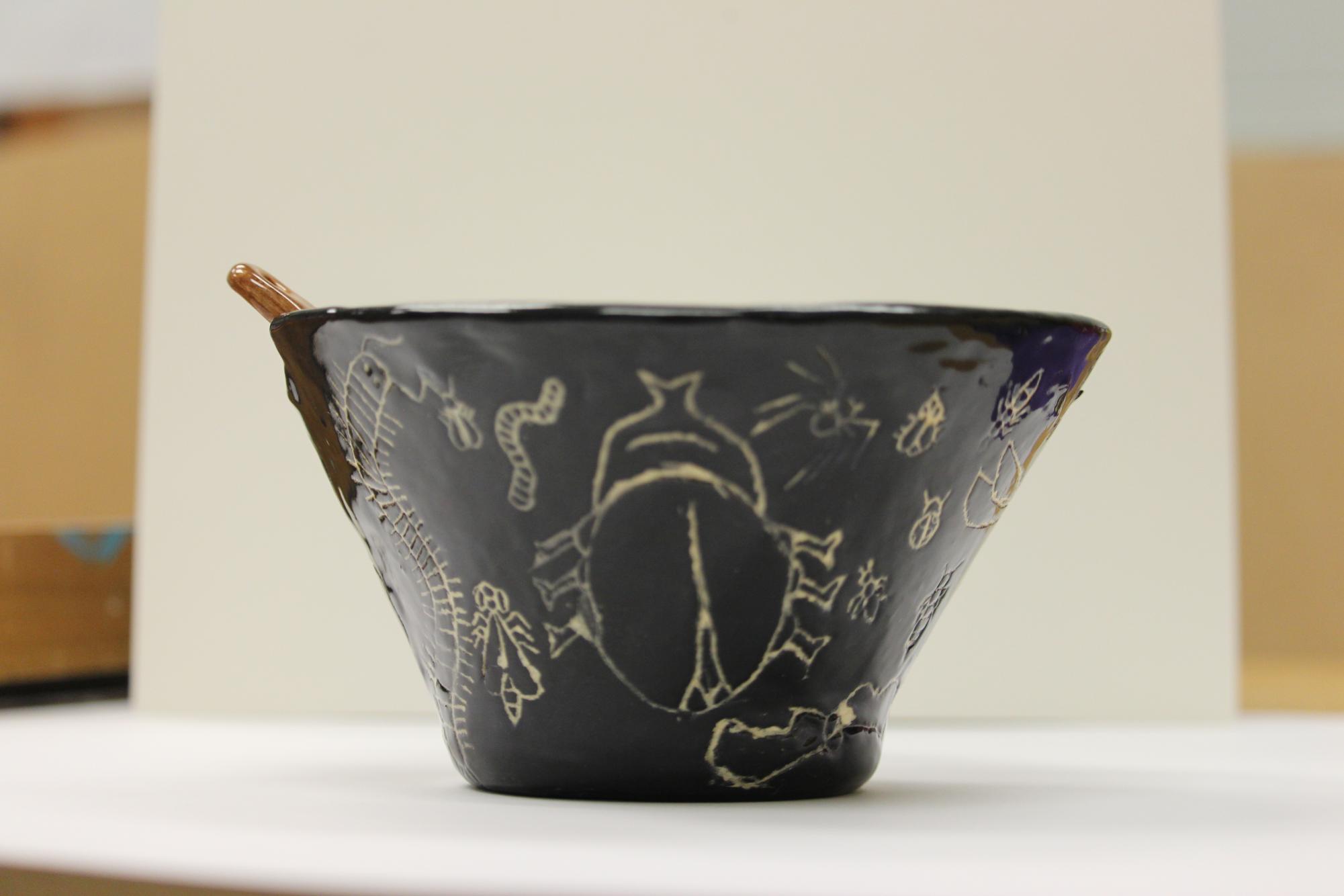
Students in sculpture have been working hard this past year by individually hand-crafting bowls in an effort to fight hunger. Empty Bowls is a fundraiser where artists hone in their craftsmanship skills to create bowls to donate to the Houston Food Bank. The bowls are donated to the gala where people can donate money to receive a bowl. The proceeds go directly to families in need of homes and food in our area. Kingwood Park has donated 18 bowls.
The process of making the bowls isn’t an easy task. Without a throwing wheel, the students have to sculpt the bowls using a slab technique and a template.
“We cut out slabs of the bowls, start putting them together, and then moving the clay into the position we want it to be in,” senior Araya Wolfe said. “We fire it once it’s in the position, and then glaze it once, fire it again, glaze it again.”
With ceramics, students won’t know what the piece will look like until it’s fully completed, so making sure everything is perfect is a common struggle between artists.
“My biggest challenge is I am a perfectionist,” Wolfe said. “I want everything to be perfect and smooth and it’s never gonna be perfect and smooth.”
Perfectionism is such a struggle for Wolfe, that she based one of her bowls on it.
“Whenever you want it to be perfect, you start tearing yourself up about it, and it’s never gonna be perfect in your eyes,” Wolfe said. “In my eyes, it just turns into your brain trying to scratch at itself, eat itself from the inside out, and I’m wanting to convey that in the bowl I’m making.”
Junior Katie McCoy had the same problem trying to get her pieces to perfectly match her theme.
“My theme right now is like Pacific Ocean, so I would have to make animals in the Pacific Ocean,” McCoy said.
So far, she’s made a shark and a whale shark.
While perfectionism is a struggle among most artists, getting the technique to work is another difficulty dealt with by sculpture students.
Wolfe and Hanson have used sgraffito in their pieces. Sgraffito is a design technique that consists of scratching the top layer of slip off a ceramic piece to show the color underneath, much like scratch art. For Hanson, the sgraffito was the hardest part.
“[My biggest struggle was] getting the sgraffito to actually sit inside the building area,” Hanson said. “In some areas, it would just not put itself inside of it.”
Another issue dealt with by sculpture students is letting go of a piece they put so much time and effort into. Sculpture teacher Emily Herrin says that students were allowed to create one bowl for donating and one bowl to keep. Still, students struggled with giving away just one piece that they’ve grown attached to.
“Honestly, I am pretty happy to donate them, but I do feel sad that I can’t keep them because I usually like having the physical form of what I’ve accomplished,” Hanson said.
Empty Bowls doesn’t only benefit the nonprofit receiving them, but it also opens artists up to new mediums and creations that they wouldn’t have considered before. Herrin said that the slab method was new to many students, and learning to perfect it was a struggle. Wolfe said through making bowls, she’s learned a valuable lesson about the process of her artwork.
“I need to stop rushing the projects that I don’t fully want to do,” she said.
Empty Bowls has taught valuable lessons to each art student making one.